AI Semantic Search for New Car Sales
By Phong Trang - Software Product Manager - thanhphong.trang@gmail.com
Overview
The Challenge: Transform Volvo’s car discovery experience by building an intelligent search system that understands customer intent, bridging the gap between natural language queries and technical car specifications.
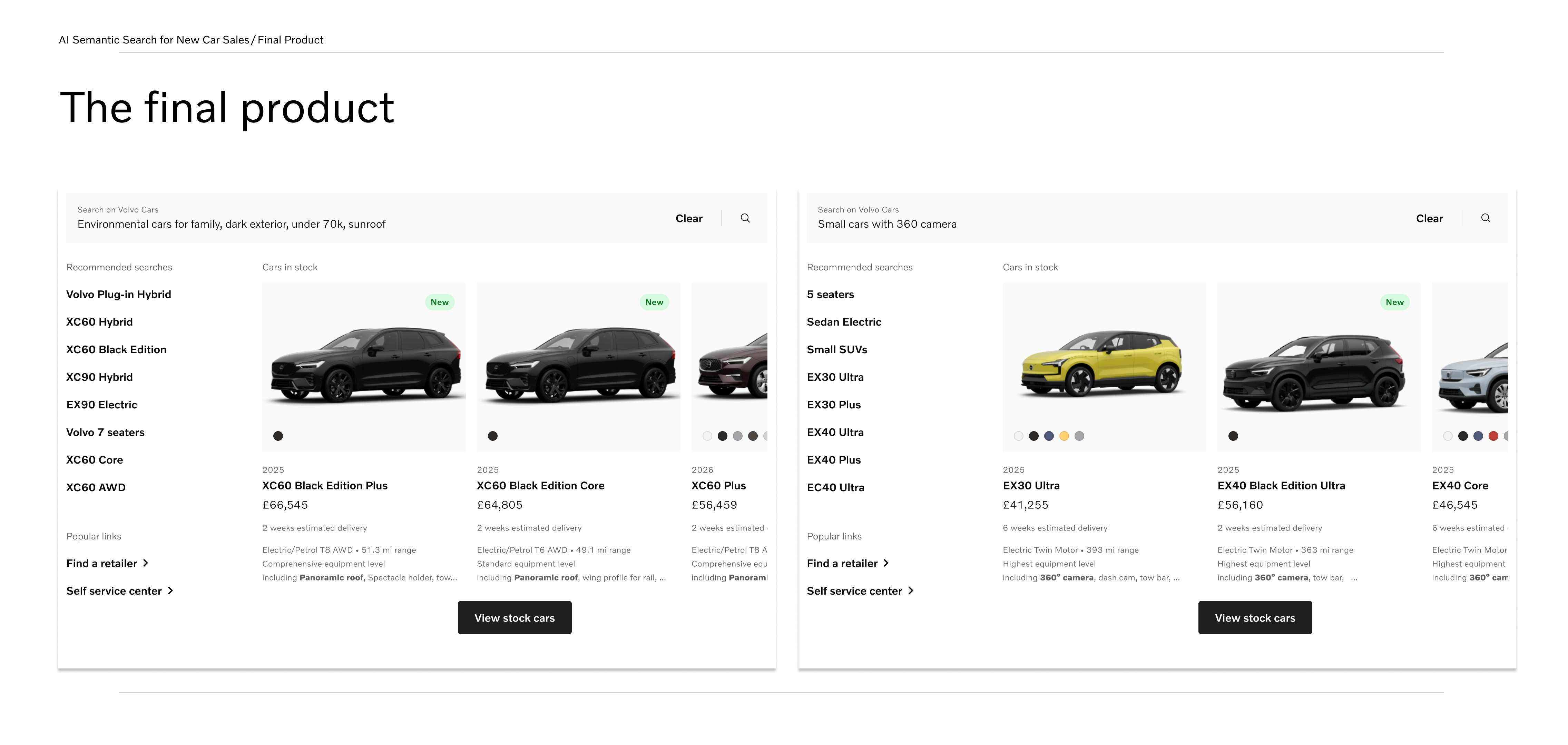
The Impact: Achieved 85% search accuracy (NDCG score), increasing 19% to Car Listing Pages, and make search user 11% more likely to complete a car purchase.
Technical Stack:





Key Metrics:
- 85% NDCG search accuracy score
- +19% traffic to Car Listing Pages from search
- +11% conversion rate for search users
- Sub-second response times at scale
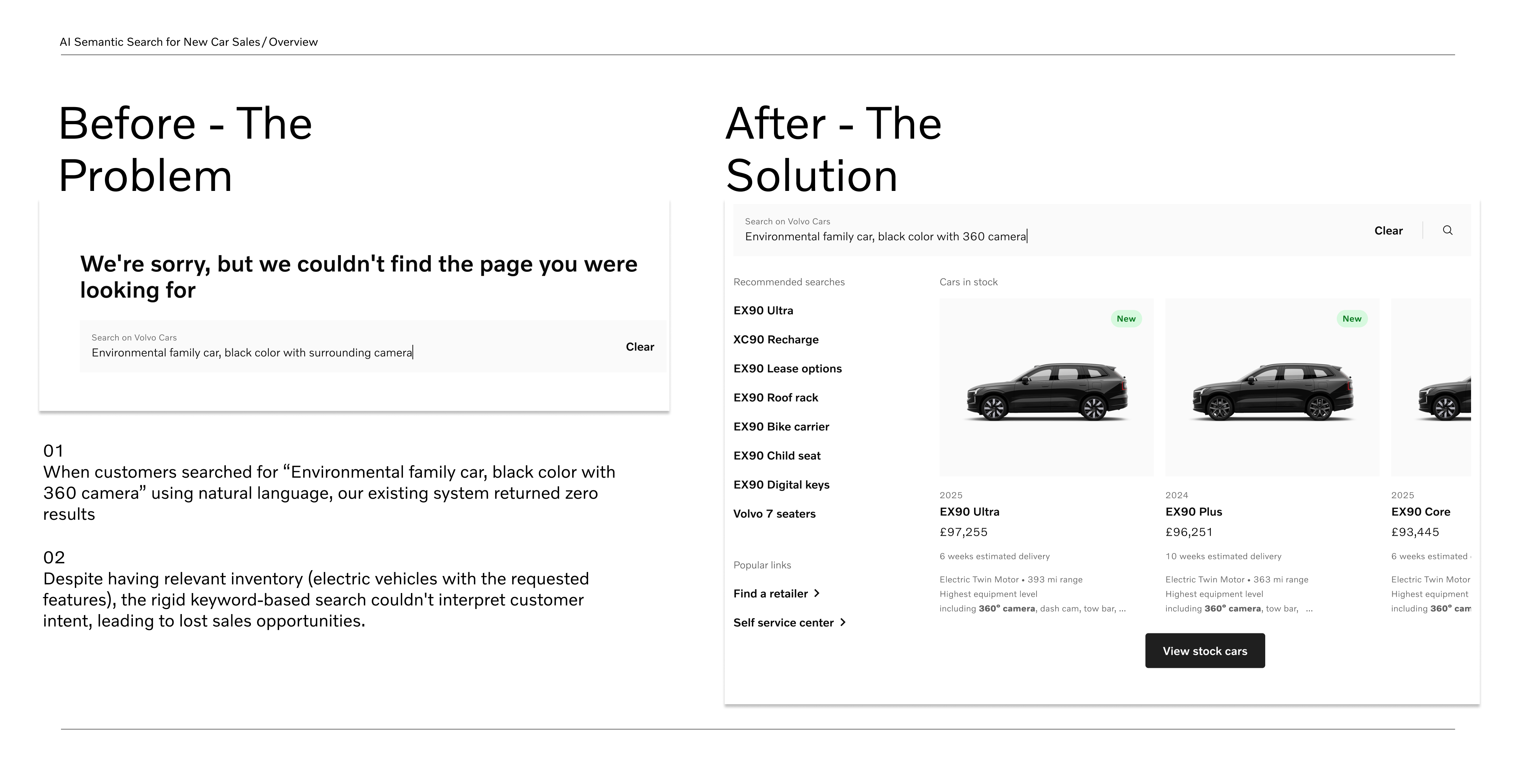
Problem Statement
💔 What Was Breaking
🚙 Complex Purchase Decisions
Cars represent the second-largest purchase after homes, with hundreds of configurations and features. Customer research typically spans weeks, but our existing search made it difficult to find the right match in inventory.
🏗️ Legacy System Limitations
The backend GraphQL system provided comprehensive car data but lacked semantic search capabilities:
- Fixed nomenclature without synonym support
- Filter-based architecture requiring exact matches
- No natural language processing layer
- Gap between customer language and system terminology
🗣️ Semantic Language Gap
A critical disconnect existed between how customers search and how we catalog cars:
- Customers: “surrounded cameras” → Our system: “360° camera”
- Customers: “family cars” → Our system: required specific model browsing
- Customers: “eco-friendly vehicles” → Our system: needed exact fuel type filters
🛒 Direct-to-Consumer Strategy Risk
The UK market pilot for transparent, haggle-free car sales required self-service discovery capabilities that our legacy search couldn’t support, threatening the strategic initiative.
💡 The Opportunity
- Revenue Recovery: Capture lost sales from customers who couldn’t find suitable cars in our existing inventory through better discovery
- Competitive Advantage: Differentiate Volvo’s direct-to-consumer experience with Google-like search intelligence while competitors rely on traditional dealership browsing
- Inventory Optimization: Convert hidden quick-delivery stock into competitive advantage by making 3-week delivery cars easily discoverable
🕵️ Discovery & Research
Data-Insight-Belief-Bet Framework
📐 Data (what we can reliably measure)
- Structured (clickstream & session): search submits, result clicks, time on search results, scroll depth, device, market, search destination (Car Listing Page, PDP, support pages), zero-result, abandonment, add-to-cart, orders, orders-with-search, latency.
- Unstructured (customer language): raw search terms (incl. misspellings, synonyms, colloquialisms), query length, language/market, intent phrases (“family car”, “surrounded cameras”, “eco-friendly”), reformulations.
The baseline facts:
- Analyzed 25,000 unique search queries from UK market data, revealing:
- 80% of queries contained 2-5 words
- High frequency of colloquial terms and misspellings
- Intent-based searches (e.g., “family car”) vs. specification searches (e.g., “XC90”)
- Geographic and cultural language variations
- Achieved 85% NDCG on 🇬🇧 UK, 72% NDCG in 🇩🇪 DE with English-only indexing performing better than German-only (~0.72 vs 0.58 NDCG).
- Launch impact: +19% traffic to Car Listing Pages from search and search users +11% more likely to purchase.
💠 Canonical metrics & formulas
- Search Interaction Rate (SIR) =
clicked results / submitted searches - Search CTR to Listing =
clicks to CLP / submitted searches - Zero-Result Rate =
searches returning 0 results / submitted searches - Search Abandon Rate =
searches with no click / submitted searches - Query Reformulation Rate =
sessions with ≥1 re-query / search sessions - Search→Order Rate =
orders with prior search / search sessions
👥 User Research Insights
🗺️ Customer Journey Mapping
Identified three primary search intents:
- 🛒 Purchase Intent: New car buyers with specific needs
- 📚 Information Seeking: Research-phase customers exploring options
- 🔧 Existing Owner Support: Current customers seeking information about their vehicles
🔬 Technical Insight
🧠 Semantic Router Investigation
Researched industry-standard approaches, focusing on the semantic router methodology:
- Intent classification through utterance databases
- Vector similarity matching using embedding models
- Real-time query processing and ranking
⚖️ Embedding Model Evaluation
Used NDCG (Normalized Discounted Cumulative Gain) as the primary evaluation metric to measure ranking quality across 1,200+ test queries to benchmark:
OpenAI text-embedding-3-largeMultilingual-e5-smallElasticsearch ELSER v2Cohere multilingual models
💡 Solution Strategy
🎯 Strategic Approach
🧭 Intent Recognition First
Rather than treating this as a pure search problem, I positioned it as an intent recognition challenge. The key insight: understand what customers want, not just what they type.
🏗️ Semantic Router Architecture
Designed a three-layer system:
- 🎭 Intent Classification: Categorize user queries into predefined intents (EV interest, car type preferences, feature requirements)
- 🔗 Semantic Matching: Use vector similarity to find relevant cars in inventory
- 🎯 Intelligent Reranking: Apply cross-encoder models for final result optimization
🚀 Key Product Decisions
🔀 Multi-Modal Search Approach
- Combined semantic search (dense retrieval) with traditional lexical search
- Weighted field approach: “summary” fields (model, price, specs) vs. “details” fields (features, accessories)
- Dynamic query expansion using LLM capabilities
🌍 Multilingual Strategy
For German market expansion:
- Discovered English-only indexing performed better than German-only (0.72 vs 0.58 NDCG)
- Simplified evaluation and maintenance processes
- Enabled consistent performance across markets
⚡ Performance-First Design
- Optimized for 600-1,000 car inventory sizes
- Computational efficiency for real-time search
- Scalable architecture supporting multiple markets
🧪 Interactive Prototype
Built a real-time demo application using semi-live UK market data to showcase the semantic search capabilities and validate performance with stakeholders.
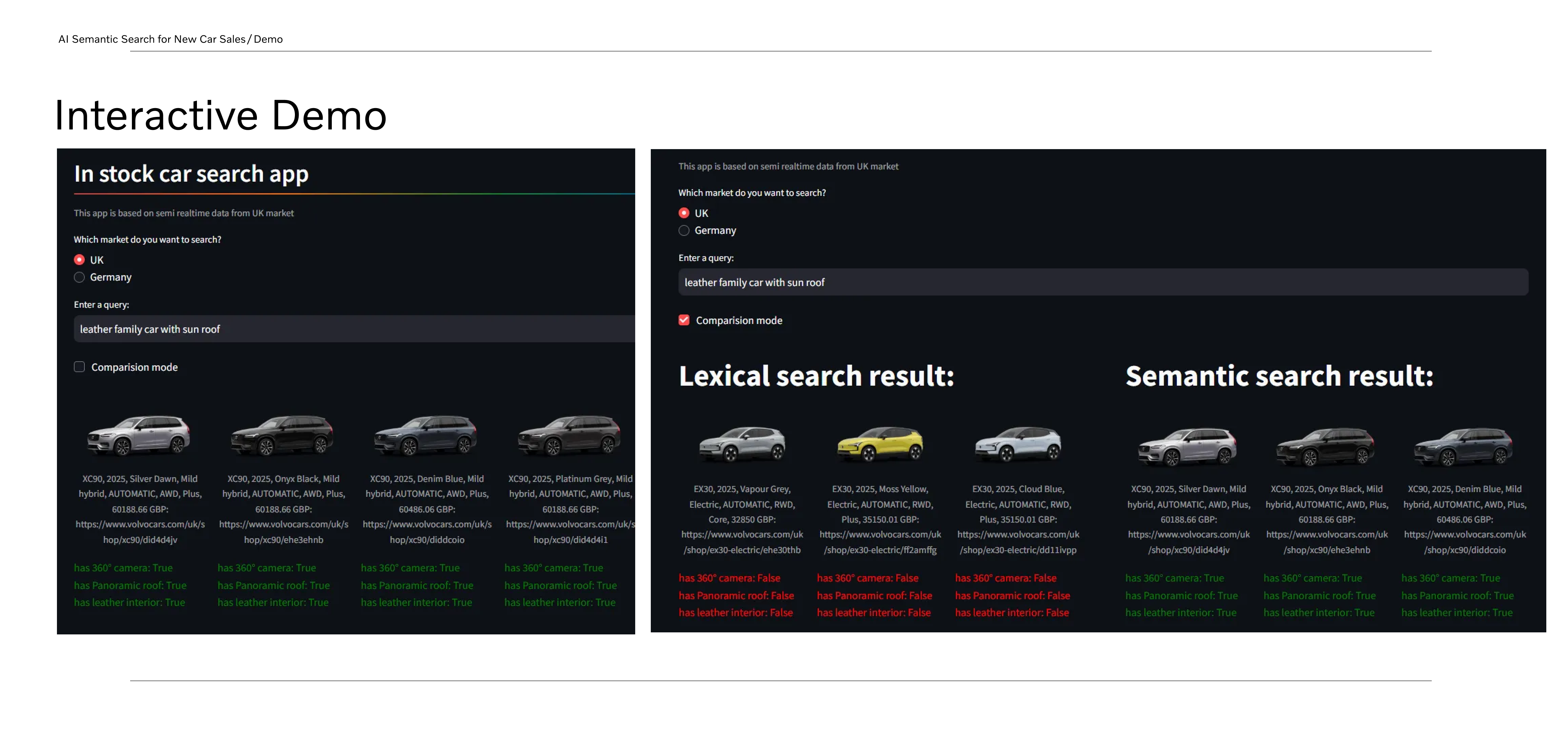
Comparison:
- Lexical Search Results: Traditional keyword matching showing limited, often irrelevant matches for “leather family car with sun roof”
- Semantic Search Results: Intelligent understanding that surfaces relevant XC90 models with actual leather interiors, panoramic roofs, and family-friendly features
💡 The Power of Context
Notice how semantic search correctly identifies that “family car” means larger SUV models (XC90) rather than compact cars (EX30), and “sun roof” maps to “panoramic roof” in the vehicle specifications - exactly the kind of intelligent interpretation that traditional search systems miss.
🛠️ Implementation
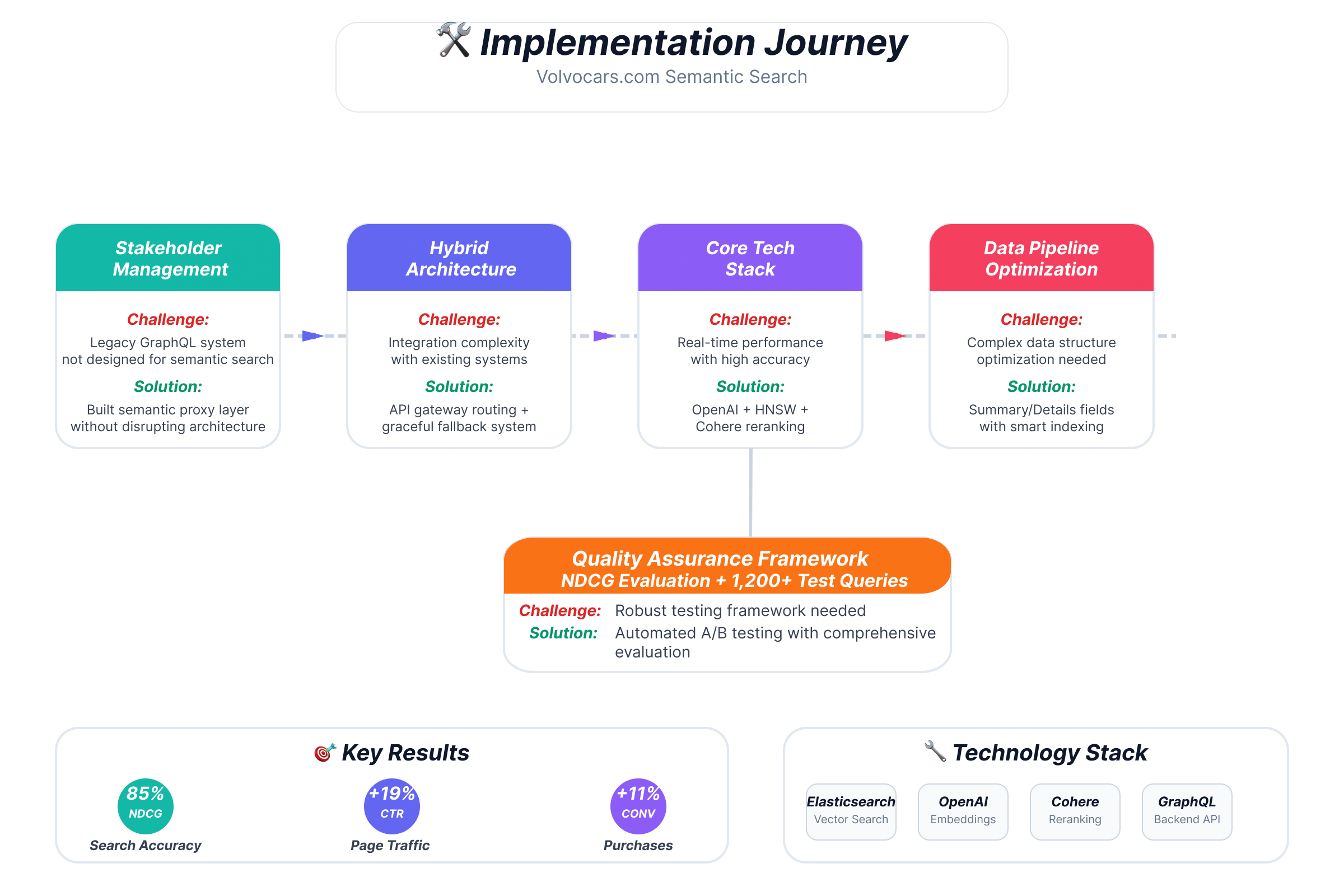
System Architecture
🪙 Cost-Effective Implementation
- Monthly cost: ~150 SEK for UK market (250 daily queries)
- Processing: 1M tokens at $1.3 + 1000 queries at $2.00
- ROI: Significant inventory utilization improvement
📊 Results & Impact
🎯 Performance Metrics
🏆 Search Accuracy Achievement
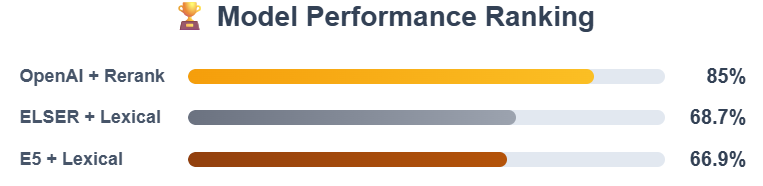
- 85% NDCG score with OpenAI embedding + Cohere reranking
- 19% improvement over best traditional approach (E5 + lexical search)
- 77% standalone semantic search performance vs 70% for multilingual-e5-small
🥇 Model Performance Ranking
🌍 Cross-Market Validation
- UK Market: 85% NDCG performance
- German Market: 72% NDCG performance (English-only indexing)
- Consistent performance across 1,200+ diverse test queries
💼 Business Impact
🎯 Conversion Funnel Improvements
- 19% increase in traffic to Car Listing Pages from search results
- 11% higher purchase completion rate among search users
- Significant improvement in search-to-conversion pathway
😊 Customer Experience Improvements
- Semantic query understanding (natural language to car features)
- Reduced search friction and improved discoverability
- Enhanced inventory utilization for quick-delivery options
⚡ Technical Achievements
- Sub-second search response times
- Scalable architecture supporting multiple markets
- Robust multilingual capabilities
📈 Operational Efficiency
- Reduced customer support queries about search functionality
- Streamlined inventory management through better visibility
- Automated evaluation framework reducing manual testing overhead
Tech Stack
- Embedding Models: OpenAI text-embedding-3-large, Multilingual-e5-small
- Reranking: Cohere multilingual models
- Search Engine: Elasticsearch ELSER v2
- Backend: GraphQL API
- Evaluation: NDCG metrics, custom testing framework
Skills Demonstrated
- AI/ML Product Strategy
- Semantic Search & NLP
- Vector Databases & Embeddings
- User Research & Intent Analysis
- A/B Testing & Metrics
- Cross-functional Leadership
- API Integration
- Stakeholder Management